Picking the right Drawer Box isn’t just about how it looks. There’s a lot more to consider—like how you'll actually use it daily, the size of your cabinets, and how it’ll fit into the space and setup. For example, a kitchen drawer that holds cast-iron pans needs solid support, while a bedroom drawer for scarves doesn’t require the same strength. In real-world projects, those tiny mistakes can end up costing a pretty penny once everything’s installed. Sure, a drawer might look perfect in a sample, but when you take a closer look, you might spot weak joints, uneven surfaces, or rough movement when you pull it out under load. Make sure to measure the width, depth, height, clearance, and what kind of slide system you want—write all this down, don’t just wing it. Guessing usually ends up wasting time and effort.
Now, these 10 tips cover all the essentials—material quality, joinery, how much weight it can handle, the finish, moisture resistance, customization options, and how reliable your supplier is. Plus, think about how it’s gonna feel after thousands of open-and-close cycles. Don’t just look at the catalog pictures—test the joint strength yourself; that’s the real deal. Ask for details on the materials used, production tolerances, testing info, and care Instructions. A good supplier should answer your questions clearly and consistently, and should be okay with sharing samples, drawings, and delivery details. Certifications are a plus, but always verify—they’re not automatically a guarantee of quality. Honestly, no single feature is a magic bullet for perfection. Even seasoned buyers mess this up sometimes. The key is balancing performance, price, appearance, and ease of maintenance long-term. Taking a bit of time to review everything now can save you from rattling fronts, swollen panels, and the headache of replacements down the line.
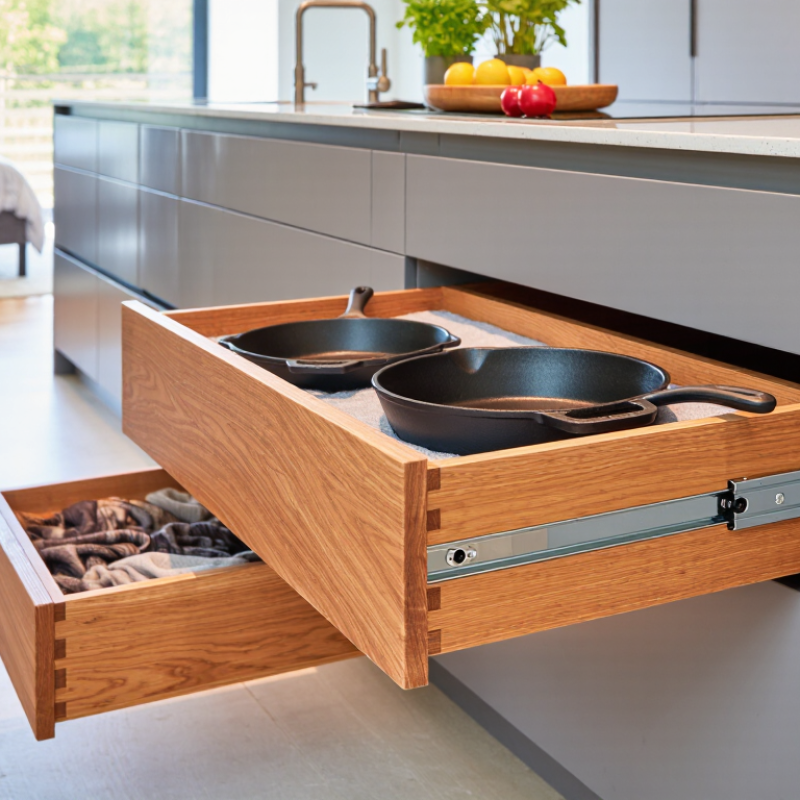
10 Tips for Choosing the Right Drawer Box
Define Your Drawer’s Purpose, Load, and Usage Frequency
Choosing the right drawer box begins with an honest question: what will it hold? A cutlery drawer needs shallow space and smooth movement. A deep pantry drawer may carry bottles, cans, or heavy cookware. Start with the heaviest realistic load, not the average one. Do not size it for an empty drawer. Measure the internal width, depth, and height carefully, leaving room for hardware and movement. Weight is only part of the decision.
Opening frequency changes the required construction. A bedroom drawer opened twice daily has different demands from a kitchen drawer used every few minutes. Frequent use benefits from rigid joints, stable panels, and reliable runners. A drawer exposed to moisture needs sealed surfaces and protected edges. Under a sink, even small leaks can cause swelling or misalignment. These details are easy to overlook.
I once selected a box based only on appearance and available space. It looked suitable, but loaded cookware made the front tilt slightly. That mistake taught me to test real conditions before installation. Load the box with similar items, then open it repeatedly. Listen for scraping. Check whether the front stays level. If movement feels loose, reconsider the load rating, construction, or runner support. A small test can reveal more than a product image. Real conditions matter.
Typical drawer load ranges vary by application. Use the expected contents, access frequency, and drawer dimensions to select an appropriate box construction and hardware capacity.
Lightweight drawers for cutlery and clothing generally require less capacity, while drawers storing cookware or tools need stronger boxes, reinforced joints, and higher-rated runners. Frequent-use drawers should also prioritize smooth operation and durable materials.
10 Tips for Choosing the Right Drawer Box?
Tip: Measure the cabinet opening before selecting a drawer box. Record the width, height, and depth with a reliable steel tape. Measure the opening at the front, center, and back. Cabinets are not always perfectly square. The smallest measurement usually provides the safest reference.
Tip: Check the usable drawer space, not only the opening size. Look for hinges, doors, face frames, shelves, and plumbing pipes. These obstacles can reduce the available depth or width. Leave room for the selected slide system. Slide requirements vary, so confirm their clearance before ordering.
Tip: Measure twice. Cut once. I have seen small errors create expensive fitting problems. Write measurements in millimeters or inches, but never mix both systems. Check whether the cabinet uses an inset or overlay front. This detail changes the visible drawer size and front position.
Tip: Compare the measured space with the drawer box’s outside dimensions. Do not rely on a listed nominal size alone. A box that appears suitable may bind when the cabinet walls lean inward. Test the opening with a temporary cardboard model if the fit is uncertain. It is not perfect, but it reveals problems quickly.
Tip: Consider Drawer Box Packaging during planning. Packaging should protect corners without hiding critical dimensions. Confirm the packed box size if delivery access is narrow. Also inspect the cabinet floor for uneven areas. A level drawer may still rub against a sloping base. Record every adjustment before final production.
| Tip | Measurement Dimension | What to Measure | Example Data | How to Use the Measurement | Recommended Check |
|---|---|---|---|---|---|
| 1 | Cabinet opening width | Measure the clear distance between the left and right inside edges of the cabinet opening. | 24 in (609.6 mm) | For many side-mount slides requiring 1/2 in (12.7 mm) clearance per side, the drawer-box outside width is approximately 23 in (584.2 mm). | Measure at the front, center, and rear. Use the smallest reading. |
| 2 | Cabinet opening height | Measure the clear vertical opening from the bottom mounting surface to the top obstruction. | 8 in (203.2 mm) | Allow room for the slide system and drawer movement. A box height of approximately 6.5–7 in (165.1–177.8 mm) may be suitable, depending on the hardware. | Check the smallest height at both front corners and the back. |
| 3 | Available cabinet depth | Measure from the inside face of the cabinet front to the back panel or the deepest obstruction. | 22 in (558.8 mm) | Choose a drawer box depth shorter than the available space. A 20 in (508 mm) box can provide approximately 2 in (50.8 mm) of total clearance. | Do not measure only the cabinet exterior depth. |
| 4 | Slide length | Confirm the slide length offered by the selected hardware and compare it with the usable cabinet depth. | 20 in (508 mm) slide | A full-extension slide commonly requires a drawer box depth that matches or is slightly shorter than the slide length, subject to the slide manufacturer's specification. | Keep the slide length equal to or shorter than the usable cabinet depth. |
| 5 | Side clearance | Identify the lateral space required between each drawer-box side and the cabinet or slide. | 1/2 in (12.7 mm) per side for a common side-mount configuration | Subtract 1 in (25.4 mm) from the cabinet opening width to estimate the drawer-box outside width. | Clearance varies by slide type; verify the hardware specification before ordering. |
| 6 | Drawer-box outside width | Measure the complete outside dimension from the outer face of one drawer side to the outer face of the other. | Opening: 24 in; side clearance: 1/2 in per side; box width: 23 in | The outside width must fit the opening while preserving the required operating clearance. | Do not confuse outside box width with the usable inside storage width. |
| 7 | Drawer-box inside width | Measure between the inside faces of the drawer sides after selecting the material thickness. | Outside width: 23 in; 1/2 in material on each side; inside width: 22 in (558.8 mm) | For two sides that are each 1/2 in thick, subtract 1 in from the outside width. | Use actual material thickness, because nominal and actual sizes can differ. |
| 8 | Drawer-box height | Measure the vertical box height separately from the decorative drawer front height. | Available opening: 8 in; box height: 6.5 in (165.1 mm) | The drawer front may be taller than the box, but it must not interfere with adjacent fronts, rails, or cabinet components. | Maintain a visible and functional gap between neighboring drawer fronts. |
| 9 | Bottom clearance and base position | Check the vertical space below the drawer box for the slide, mounting hardware, and cabinet bottom. | Minimum available space below box: 1/4 in (6.35 mm) | Use the clearance required by the selected undermount or bottom-mount hardware; the exact requirement is hardware-specific. | Look for face-frame lips, bottom stretchers, screws, and uneven cabinet floors. |
| 10 | Final fit and measurement tolerance | Compare all smallest opening measurements with the planned outside drawer-box dimensions before fabrication. | Three width readings: 24, 23 15/16, 24 in; design from the smallest reading: 23 15/16 in | Use the smallest reliable measurement and avoid adding material that reduces the required clearance. | Record measurements in both inches and millimeters; 1 in = 25.4 mm. |
Measurement note: The example calculations assume a common side-mount slide arrangement with 1/2 in (12.7 mm) clearance on each side. Slide clearance, mounting position, and required drawer-box dimensions vary by hardware type, so the selected slide specifications should be confirmed before construction.
Choosing the right drawer box starts with material, not appearance. Plywood offers stable layers and resists splitting around screws. Solid wood feels premium, but seasonal movement can change the fit. MDF provides a smooth surface and consistent dimensions, yet moisture can weaken exposed edges. The USDA Forest Products Laboratory identifies moisture variation as a major cause of wood movement. Measure the room’s humidity, too.
Construction decides how the box performs daily. Dovetail joints spread stress across interlocking fingers. Stapled or doweled joints cost less, but they need accurate assembly and strong adhesive. A 2023 report from the Architectural Woodwork Institute emphasizes precise joinery, proper tolerances, and durable finishing for long-term cabinet performance. Full-extension runners also improve access, especially for deep drawers. Test the box with real weight.
For a Custom Drawer Box, match the material to its environment. A kitchen near a dishwasher needs sealed edges and moisture-resistant construction. A bedroom drawer may need less protection but still benefits from a rigid bottom panel. The 2024 U.S. Houzz Kitchen Trends Study reported that 76% of renovating homeowners upgraded their cabinets, showing how often drawer performance becomes part of a wider remodel. Do not trust appearance alone. I have seen attractive boxes loosen because the bottom panel was too thin. That mistake deserves a second look.
Choosing a High-Quality Drawer Box starts with accurate dimensions. Measure the cabinet opening, then subtract the manufacturer’s required side clearance. Check the box depth against the runner length, especially under sinks or beside appliances. A box that is only 3 mm too deep can scrape the cabinet back. The USDA Forest Products Laboratory’s Wood Handbook places typical indoor wood moisture content near 6–8%, so stable material matters. I still measure twice; rushed measurements cause expensive adjustments.
Tip 1: Compare joinery, not just appearance. Dovetail joints resist pulling forces and suit wide, heavy drawers. Box joints can perform well when glued and machined precisely. Stapled corners may work for light storage, but they deserve closer inspection. Look for a fully captured bottom panel, clean corners, and consistent gaps.
Tip 2: Separate hardware capacity from box strength. ANSI/KCMA A161.1 testing includes a 15-pound drawer-load test and 25,000 opening cycles. That benchmark helps, but real use can be harsher. Pots, tools, and pantry goods create concentrated loads. Choose runners rated above the expected weight, then confirm the rating is dynamic, not merely static. A 100-pound label may assume balanced loading. I have seen strong boxes fail because the fasteners were undersized. Cite the test standard, material thickness, and installation requirements before ordering.
10 Tips for Choosing the Right Drawer Box
Select the drawer slide type before building or ordering the drawer box. Side-mount slides suit many standard cabinets and tolerate minor installation errors. Undermount slides create a cleaner appearance, but they demand accurate drawer dimensions and a square cabinet opening. Center-mount slides work for lighter loads and simpler furniture. Check the slide’s load rating, extension length, and required clearance against your actual drawer measurements.
Installation quality often matters more than the slide category. Measure the cabinet opening at several points because walls are not always parallel. Use a level, a sharp pencil, and a small spacer to maintain equal gaps. Pre-drill screw holes in plywood to reduce splitting. Keep the slide bodies parallel from front to back. Even a slight angle can cause scraping, uneven closing, or premature wear. Test the drawer with its intended contents, not an empty box.
I once corrected a drawer that looked perfectly aligned but opened poorly. The cabinet was square, yet one slide sat two millimeters higher. That small error changed the whole feel. Do not trust appearance alone. Check movement by hand and listen for rubbing sounds. A soft-close mechanism also needs enough closing force and correct adjustment. Sometimes, choosing a simpler slide is wiser than forcing a complicated installation into an unsuitable cabinet.
Choosing the right drawer box starts with the cabinet’s visual language. A sleek contemporary cabinet needs clean, frameless drawer boxes with square edges and concealed runners. Shaker cabinets usually suit simple five-piece fronts, subtle reveals, and warm wood or painted finishes. Traditional cabinets can accept thicker boxes, visible joinery, and deeper natural tones. The drawer should feel like part of the cabinet, not an unrelated metal container.
Tip 1: Match the drawer box finish to the cabinet interior. Light maple can soften dark cabinetry, while walnut adds weight to pale doors. Houzz’s 2024 U.S. Kitchen Trends Study reports that 76% of renovating homeowners upgraded their cabinets. That investment makes interior coordination important. Measure clearances carefully. A beautiful box still fails when it rubs against a hinge.
Tip 2: Connect construction to daily use. Use dovetail joints for heavy cookware and reinforced bottoms for wide drawers. Smaller drawers can use a slimmer box, especially for utensils. In my workshop experience, designers often choose hardware first and check storage needs later. That order creates problems. I still make that mistake when rushing. Review the cabinet style, load, and opening frequency together. For retail or protective presentation, Custom Drawer Box Packaging can echo the same grain, color, and precision as the installed cabinetry. A consistent detail builds trust before the drawer is even opened. (Sources: Houzz 2024 U.S. Kitchen Trends Study; NKBA 2024 Design Trends Report)
A drawer box should feel solid before it looks attractive. Press the bottom panel gently and check for movement. Examine joint alignment, surface smoothness, and the consistency of the finish. Small gaps may grow after repeated use. Measure the internal width, depth, and height carefully. A two-millimeter mistake can cause frustrating installation problems. Ask whether the material resists moisture, scratches, and daily impacts. Kitchens and bathrooms need stronger protection than dry storage areas.
Maintenance needs deserve equal attention. Look for surfaces that clean easily with a damp cloth. Avoid designs with deep grooves that collect crumbs and dust. Check whether the hardware can be adjusted without special tools. Ask about replacement parts and written care instructions. Keep it practical. A beautiful drawer that needs frequent repairs becomes expensive quickly. I once focused too much on appearance and underestimated cleaning time. That decision still bothers me.
Set a complete budget, including delivery, installation, adjustments, and future replacements. Compare samples, not only online photographs. Request clear specifications, production times, inspection methods, and warranty terms from each supplier. A reliable supplier answers precise questions and reports delays early. Ask for a production sample before ordering many units. Check packaging quality when it arrives; crushed corners often reveal weak handling procedures. References from recent customers can provide useful evidence. Still, no supplier is perfect. Review communication, consistency, and willingness to correct mistakes before trusting a large order.
Plywood offers stable layers and resists splitting around screws. It works well for everyday cabinet use. Solid wood feels premium, but humidity can change its fit. MDF stays smooth and consistent, though exposed edges dislike moisture.
Measure room humidity before selecting materials. Seasonal moisture changes can make solid wood expand or contract. A kitchen near a dishwasher needs sealed edges. Small gaps may become binding problems.
Dovetail joints spread stress across interlocking fingers. They suit drawers carrying frequent, heavy loads. Stapled or doweled joints cost less. They still require accurate assembly and strong adhesive.
Use a rigid bottom panel sized for the intended weight. Heavy cookware needs more support than bedroom clothing. A thin bottom can sag or loosen. I once trusted appearance too much.
Side-mount slides suit many standard cabinets and tolerate small installation errors. Undermount slides look cleaner but need precise measurements. Center-mount slides suit lighter loads and simpler furniture.
Measure the cabinet opening at several points. Walls may not be parallel. Keep both slide bodies parallel from front to back. A small spacer helps maintain equal gaps.
Check the opening width, depth, height, slide clearance, and expected load. Match the material to the room’s moisture level. Confirm measurements twice. One overlooked millimeter can change the whole fit.
Load it with real contents, not an empty box. Open and close it slowly. Listen for rubbing sounds and uneven movement. A drawer can look aligned and still perform poorly. Movement tells the truth.
Choosing the right Drawer Box starts with understanding how it will be used. Consider the drawer’s purpose, expected load, and frequency of use before selecting its size and construction. Carefully measure the cabinet opening, available depth, width, and height to ensure a proper fit. Then compare materials, joint styles, wall thicknesses, and weight capacities to find a balance between durability, appearance, and cost. The drawer slide type and installation method should also match the box dimensions and expected performance.
A well-chosen Drawer Box should complement the cabinet’s overall design, whether the style is simple, modern, traditional, or practical. Beyond appearance, evaluate surface quality, ease of cleaning, maintenance requirements, warranty terms, delivery reliability, and supplier service. Reviewing these factors together helps prevent installation problems, improves daily functionality, and supports long-term value. By planning carefully and comparing options based on actual needs, you can select a drawer solution that is stable, attractive, dependable, and suitable for your budget.