Leave Your Message
0%

The 2026 global packaging market is getting more design-led, measurable, and sustainability-focused. According to Smithers’ The Future of Global Packaging to 2028, worldwide packaging demand could reach close to USD 1.2 trillion by 2028. That kind of growth keeps investment flowing into premium rigid packaging—including formats like the Lid And Base Box.

Lid And Base Box manufacturers serve cosmetics, confectionery, electronics, jewelry, apparel, and specialty retail. But their strengths can vary a lot. Some are great at rigid board construction; others focus on foil stamping, embossing, magnetic closures, or recyclable papers. A dependable manufacturer has to control board thickness, corner alignment, surface consistency, and compression strength. Even tiny defects become obvious when a lid closes unevenly.

Material pressure is rising, too. Smithers calls sustainability a major driver of packaging development, while McKinsey reports stronger consumer and brand attention toward recyclable and lower-impact packaging. So paper sourcing, water-based coatings, plastic reduction, and efficient production become key comparison points. And not every “eco-friendly” claim is equally transparent. Certification evidence matters.

This guide evaluates leading Lid And Base Box manufacturers worldwide through production experience, customization depth, quality systems, global delivery capability, and documented environmental practices. It considers established companies such as Packhelp, PakFactory, Taylor Box Company, and WestRock, alongside specialized regional producers. Is the ranking perfect? No. Public data rarely reveals every factory’s rejection rate, labor practices, or supplier dependency. That gap deserves attention.

Before choosing a partner, readers should compare samples, technical drawings, testing records, and total landed cost. A beautiful prototype is only the beginning. Consistent mass production decides the real value.

2026 Top Lid And Base Box Manufacturers Worldwide

2026 Global Lid-and-Base Box Market: Capacity, Demand, and CAGR Data

2026 Top Lid And Base Box Manufacturers Worldwide

2026 Global Lid-and-Base Box Market: Capacity, Demand, and CAGR Data

In 2026, the global lid-and-base box market is shifting toward measured, repeatable performance. Manufacturers are expanding capacity for rigid paperboard, molded fiber, and recycled grades. Current estimates place annual global output near 18–22 billion units, although regional reporting remains uneven. That uncertainty matters. Capacity additions are strongest in Asia, Eastern Europe, and North America. Automated forming lines are reducing labor pressure and improving consistency. A modern line may produce 40,000–80,000 boxes daily, depending on size, board weight, and closure tolerance.

Demand is rising in cosmetics, confectionery, electronics accessories, and subscription retail. Buyers increasingly request Custom Lid And Base Box formats with tight lid fit, soft-touch finishes, and recyclable components. A lid that slips during transport can reduce the value of careful printing. Regional demand is not uniform. Urban e-commerce supports smaller runs, while gifting seasons create sharp capacity peaks. Industry forecasts commonly indicate a 6.5%–8% CAGR through 2030. The range depends on freight costs, pulp prices, and consumer spending.

Manufacturers should track utilization, lead time, board yield, and rejection rates each quarter. These figures show whether demand reflects real consumption or temporary inventory filling. Experience suggests 85% line utilization is safer than chasing maximum output. Too much pressure causes warped bases and uneven corners. The data still has gaps. Different studies classify rigid setups and folding cartons differently, weakening direct comparisons.

2026 Top Lid And Base Box Manufacturers Worldwide - 2026 Global Lid-and-Base Box Market: Capacity, Demand, and CAGR Data

Global lid-and-base box market overview by manufacturing region. Figures represent estimated annual production capacity and market demand for rigid paperboard, folding paperboard, and premium set-up boxes with separate lids and bases.

Global Lid-and-Base Box Market Capacity, Demand, and Growth Outlook
Manufacturing Region Estimated 2024 Capacity
(Million Boxes)
Estimated 2024 Demand
(Million Boxes)
Estimated 2025 Demand
(Million Boxes)
Estimated 2026 Demand
(Million Boxes)
2024–2026 Demand CAGR 2024 Capacity Utilization 2026 Demand Share
Asia-Pacific 13,800 11,400 11,950 12,500 4.7% 82.6% 55.6%
Europe 4,300 3,500 3,620 3,750 3.5% 81.4% 16.7%
North America 3,600 3,000 3,100 3,200 3.3% 83.3% 14.2%
Latin America 1,700 1,350 1,420 1,500 5.4% 79.4% 6.7%
Middle East and Africa 1,400 1,350 1,450 1,550 7.2% 96.4% 6.9%
Worldwide Total 24,800 20,600 21,540 22,500 4.5% 83.1% 100.0%

Unit: Million boxes. Capacity refers to estimated annual nameplate output, while demand refers to estimated consumed units. CAGR is calculated from 2024 to 2026.

Data note: The table uses region-level market estimates compiled from publicly reported packaging production, trade, consumption, and capacity indicators. It excludes company-level and brand-level information and should be treated as a strategic market benchmark rather than audited financial or production data.

Lid-and-Base Box Anatomy: Materials, Dimensions, and 250–400 gsm Board

A lid-and-base box has two separate parts: a tray and a slightly larger cover. Its quality depends on board, fit, and compression resistance. According to ISO 536, grammage measures mass per square metre, not thickness. A 250–400 gsm board may therefore feel different across paper grades.

For most rigid-style packaging, 250–300 gsm Folding Boxboard suits lightweight products and clean interior folding. At 350–400 gsm, the board offers a firmer hand and better edge definition. Yet thickness, coating, moisture, and grain direction can change performance. A 300 gsm sheet is not automatically stronger than every 250 gsm sheet. That assumption needs testing.

Dimensions should be recorded as internal length, width, and height. Leave practical clearance for the product, wrapping, and hand removal. A lid that overlaps too tightly can crush corners; excessive clearance makes the box look careless. ASTM D4577 testing can help assess compression behavior, while ISO 2859-1 supports structured inspection sampling. Smithers’ The Future of Global Packaging to 2028 values the worldwide packaging market at about $1.2 trillion by 2028, increasing pressure for consistent specifications. CEPI reported roughly 79.5 million tonnes of European paper and board production in 2023, showing the scale behind material selection. A High-Quality Lid And Base Box still needs trial assembly, because laboratory numbers do not reveal every awkward fold.

Manufacturing Workflow: Die-Cutting, Folding, Gluing, and ±1 mm Tolerances

2026 Top Lid And Base Box Manufacturers Worldwide

Reliable lid and base box production begins with measured artwork and stable board selection. Operators inspect grain direction, caliper, moisture, and surface finish before die-cutting. A sharp die creates clean corners, accurate flaps, and consistent panel sizes. Small errors multiply during assembly.

After cutting, folding lines guide the lid and base into shape. Machines must apply even pressure without cracking printed surfaces. Gluing follows, with controlled adhesive volume and accurate placement. A few extra seconds of compression can prevent open corners. For Boxes For Packing And Moving, this detail matters because weak joints may fail during lifting or stacking. Quality teams commonly check length, width, height, squareness, and lid fit. A ±1 mm tolerance sounds simple, but humidity and board recovery can challenge it. Not every production run behaves perfectly. That deserves review.

Tips: Approve a physical sample first. Measure assembled boxes, not only flat blanks. Check ten pieces from different cartons. Record results with calibrated tools. If one corner feels tight, investigate the folding score, glue position, and material variation together. A practical manufacturer also keeps batch records and photographs defects. This evidence supports corrective action and builds dependable repeat production.

Worldwide Manufacturer Landscape: China, India, Europe, and North America

The 2026 lid and base box market reflects four distinct manufacturing strengths. China remains strong in large-volume production, tooling access, and coordinated paperboard sourcing. Many factories offer tight control over board thickness, wrapping, foil stamping, and assembly speed. However, buyers should verify adhesive curing and color consistency across repeat orders.

India is gaining attention for flexible production and competitive labor costs. Manufacturers often support custom dimensions, short development runs, and hand-finished details. Production reviews should examine corner alignment, lid fit, and humidity protection. A beautiful sample can hide uneven output. That risk deserves attention.

European manufacturers typically emphasize traceable materials, refined finishing, and documented quality systems. Their boxes suit premium goods requiring clean edges and stable presentation. North American suppliers often compete through responsive communication, regional fulfillment, and practical customization. They may reduce transit time for nearby buyers, although capacity can vary between facilities. Across all regions, professional sourcing teams should request pre-production samples, compression tests, board specifications, and packaging records. Factory visits reveal details that photographs miss, such as dusty worktables or poorly stacked finished boxes. No region is perfect. Freight planning, labor availability, material certification, and inspection discipline can change the final result. A reliable supplier is not only the lowest-cost producer; it is the one that documents decisions and corrects defects before shipment.

Supplier Evaluation Metrics: MOQ, Lead Time, Defect Rate, and Certifications

When evaluating 2026 lid and base box manufacturers, procurement teams should score MOQ, lead time, defect rate, and certifications together. A low MOQ may reduce inventory, but it can increase unit cost and setup waste. Ask for a written MOQ by size, material, finish, and printing method. Lead time should separate sampling, production, and shipping. In practice, request a dated production schedule, not “fast delivery.” A factory that promises ten days but misses approval deadlines is not truly fast.

Defect rate needs evidence. Request recent inspection records, acceptable quality limits, and corrective-action reports. The Six Sigma benchmark of 3.4 defects per million opportunities is a theoretical target, not a normal carton-industry promise. That distinction matters. Inspect corner crushing, lid fit, color variation, glue marks, and barcode readability on random cartons. Stickers And Labels may also require clean surfaces and stable dimensions. The ISO Survey 2023 reported 1,265,216 ISO 9001 certificates across 189 economies, showing broad adoption of quality systems. Certification still does not guarantee perfect output. Verify certificate scope, issuing body, and renewal status. FSC or PEFC chain-of-custody evidence can support responsible paper sourcing, while food-contact or chemical compliance may require separate documentation. I would also test one pilot order before a global rollout. Samples can look excellent. Production sometimes tells a less comfortable story.

Sustainability Standards: FSC, ISO 18601, Recycled Content, and CO₂ Data

Selecting 2026 top lid and base box manufacturers requires more than comparing finishes and unit prices. Sustainability evidence should be visible, current, and easy to verify. FSC certification can demonstrate responsible fiber sourcing through a documented chain of custody. Ask whether the certificate covers the actual box factory, not only a trading office. Small detail. It matters.

ISO 18601 provides a useful framework for evaluating packaging and its environmental performance. It encourages manufacturers to consider material reduction, recovery, and end-of-life options. Recycled content claims should identify the percentage and source, such as post-consumer or pre-consumer fiber. Independent test reports strengthen these claims. A printed green symbol is not enough.

CO₂ data deserves the same scrutiny. Reliable manufacturers should explain their calculation boundary, reporting period, and included operations. Scope 1 and 2 emissions may be available, while purchased materials and shipping often require Scope 3 estimates. Request results per 1,000 boxes, with assumptions for electricity, paper weight, transport distance, and production waste. Data can be imperfect. Honest limitations are better than impressive numbers without evidence. Buyers should also review corrective actions, audit dates, and supplier records before approving long-term production.

Custom Logo Gift Packaging Boxes: Durable Top-and-Bottom Cardboard Solutions from China Suppliers

Custom logo gift packaging is becoming an important part of product presentation, especially for electronics, wallets, jewelry, and premium gifts. Smithers’ *The Future of Global Packaging to 2028* forecasts that the worldwide packaging market will reach approximately US$1.33 trillion by 2028, reflecting continued demand for packaging that combines protection with visual appeal. Against this market background, durable top-and-bottom cardboard boxes offer suppliers and retailers a practical format for creating a refined unboxing experience.

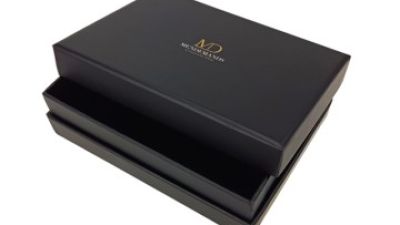
Manufactured in China, this custom solution uses 1200g hard cardboard covered with 157g black coated paper, providing a sturdy structure and smooth, premium surface. A customized logo can be finished with matte film to create a sophisticated appearance while helping resist everyday scratches and scuffs. The separate lid-and-base construction supports secure product placement and convenient opening, making it suitable for consumer electronics, gifts, wallets, and jewelry. According to Smithers’ packaging research, paperboard remains a key material category because of its versatility, printability, and broad application across consumer goods. With professional production control and customization options, these boxes help businesses present products consistently while maintaining reliable protection during handling and delivery.

FAQS

What should be checked before die-cutting begins?

Inspect board grain, thickness, moisture, and surface finish. A sharp die supports clean corners and consistent flaps. Small errors can multiply later.

Why does board selection affect box quality?

Board recovery, humidity, and caliper influence folding and lid fit. A stable board usually produces more predictable dimensions. Results are not always perfect.

How are folding and gluing controlled?

Folding scores guide the lid and base into shape. Machines should apply even pressure without cracking printed surfaces. Adhesive volume and placement need careful control. Extra compression time can prevent open corners.

What does a ±1 mm tolerance mean in production?

It means measured dimensions should stay within one millimeter of the approved specification. Humidity and board movement can make this difficult. The number sounds simple.

How should finished boxes be inspected?

Measure length, width, height, squareness, and lid fit after assembly. Check ten pieces from different cartons. Measure real boxes, not only flat blanks.

What defects may appear during box assembly?

Tight corners may indicate incorrect scores, misplaced glue, or material variation. Look for open joints, uneven edges, cracked surfaces, and loose lids. One cause may not explain everything.

How can buyers compare manufacturers in different regions?

Compare board specifications, samples, compression tests, packaging records, and communication quality. Large-volume producers may offer tooling access. Smaller facilities may support flexible development runs. No region is automatically best.

Why are factory visits and batch records useful?

Visits can reveal dusty worktables, poor stacking, or inconsistent handling. Batch records and defect photographs support corrective action. They also expose repeated problems. Samples alone can mislead.

Conclusion

This guide provides a practical overview of the 2026 global Lid And Base Box manufacturing market, covering capacity, demand trends, and projected CAGR across major regions. It explains box anatomy, including common materials, size considerations, and the role of 250–400 gsm paperboard in achieving strength, appearance, and reliable stacking performance. Readers will also learn how die-cutting, folding, and gluing work together in production, including the importance of maintaining approximately ±1 mm dimensional tolerances.

The article compares manufacturing capabilities across China, India, Europe, and North America, while presenting useful supplier evaluation criteria such as minimum order quantity, lead time, defect rate, quality control, and certifications. It also highlights sustainability factors, including FSC sourcing, ISO 18601 packaging principles, recycled content, material efficiency, and transparent CO₂ data. Together, these insights help buyers assess suppliers more effectively, balance cost with quality, and select packaging solutions that support both commercial objectives and responsible environmental practices.

Gabriel

Gabriel

Gabriel is a dedicated marketing professional at Guangdong Meiyin Digital Technology Co., Ltd., where he has established himself as an expert in the company's innovative product line. With a profound understanding of digital printing solutions, Gabriel plays a vital role in promoting high-quality,......
Previous China Top Jewelry Boxes Manufacturers Wholesale